Artwork Concept


Artist Statement
For many years, I have centered my practice on the figure of the contemplative human being, working across painting and installation.
The human figures in my work are reduced to only a head and torso, with the arms and legs omitted. The head represents the realm of thought, reflection, and questioning, while the torso signifies the center of existence that bears the weight of life. I am less interested in the human as an acting being than in the human as a thinking being. Throughout life, people are continuously shaped by their relationships, environments, and experiences. My work begins with questions about this condition of human existence.
The lines drawn on hanji (Korean paper) represent the body, while the traces of permeating and spreading color symbolize the traces of the mind. Pigment seeps into the paper, creating unpredictable marks and stains. I regard these traces as records of the memories, emotions, and relationships that accumulate throughout a person's life. Human beings exist within networks of others, society, and the environment, constantly changing through these interactions. Over time, these experiences become inseparable from both body and mind.
The heads of the figures in my work are often tilted to one side. I think of this as an “angle of contemplation.” Just as the Earth’s 23.5-degree tilt makes seasons and life possible, each person forms their own angle of thought through experience and reflection. As the weight of life deepens, so too does contemplation, while relationships and environments continually alter the direction of one's existence.
In recent years, my interest in human existence has expanded toward more fundamental questions. Where do we come from? What are we made of? My inquiry into the human condition has led me to questions concerning the origins of life, the cycles of nature, and humanity’s place within the cosmos. We are beings composed of matter forged in ancient stars, temporarily taking the form of human life. Yet my work continues to begin with the human. Through humanity, I seek to understand the world, and through human contemplation, I seek to question the meaning of existence.
To permeate is birth. To spread is life. To evaporate is death. Human beings permeate one another, influencing and transforming each other through their encounters. Even after disappearance, traces remain. Through lines and color, permeation and diffusion, I attempt to depict human beings who endure the weight of life while questioning the meaning of their existence.
Ultimately, my work returns to a single set of questions:
Who am I?
What sustains human life?
And why do we exist?
작가노트
나는 오랫동안 ‘사유하는 인간’을 작업의 중심에 두고 회화와 설치 작업을 이어오고 있다.
작품 속 인간은 팔과 다리가 생략된 채 머리와 몸통만 남아 있다. 머리는 생각하고 질문하는 정신의 영역이며, 몸통은 삶의 무게를 견디는 존재의 중심이다. 나는 행동하는 인간보다 사유하는 인간에 관심이 있다. 인간은 살아가는 동안 수많은 관계와 환경 속에서 영향을 주고받으며 끊임없이 변화한다. 나의 작업은 이러한 인간 존재에 대한 질문에서 출발한다.
한지 위에 그어진 선은 신체를 나타내고, 스며들고 번지는 색채의 흔적은 정신의 흔적을 의미한다. 물감은 한지에 스며들고 번지며 예측할 수 없는 흔적을 남긴다. 나는 이 흔적을 인간이 살아가며 형성하는 기억과 감정, 관계의 흔적으로 바라본다. 인간은 타인과 사회, 환경 속에서 살아가며 끊임없이 변화하고, 그 과정은 몸과 정신에 스며들어 존재의 일부가 된다.
작품 속 인간의 머리는 대부분 한쪽으로 기울어져 있다. 나는 이를 ‘사유의 각도’라고 생각한다. 지구가 23.5도의 기울기로 계절과 생명을 품듯 인간 또한 저마다의 사유의 각도를 형성하며 살아간다. 삶의 무게가 깊어질수록 사유는 더욱 깊어지고, 관계와 환경은 인간의 방향을 끊임없이 변화시킨다.
최근에는 인간 존재에 대한 관심이 보다 근원적인 질문으로 확장되고 있다. 인간은 어디에서 왔는가. 우리는 무엇으로 이루어져 있는가. 인간 존재에 대한 탐구는 생명의 기원과 자연의 순환, 그리고 우주 속 인간의 위치에 대한 질문으로 이어진다. 우리는 오래전 별에서 태어난 물질로 이루어진 존재이며, 잠시 인간의 형상을 빌려 살아간다. 그러나 나의 작업은 여전히 인간으로부터 출발한다. 나는 인간을 통해 세계를 이해하고, 인간의 사유를 통해 존재의 의미를 질문하고자 한다.
스미는 것은 탄생이고, 번지는 것은 삶이며, 증발하는 것은 죽음이다. 인간은 서로에게 스며들고 영향을 주며 살아간다. 그리고 사라진 이후에도 흔적으로 남는다. 나는 선과 색, 스밈과 번짐의 과정을 통해 삶의 무게를 견디며 존재의 의미를 질문하는 인간의 모습을 그리고자 한다.
나의 작업은 결국 하나의 질문으로 돌아온다.
나는 누구인가.
인간은 무엇으로 사는가.
그리고 우리는 왜 존재하는가.

Working Process (Sayu Series)
Constructing the Composition
The structure of the composition is established through the placement, tilt, and spacing of the figures. The repeated forms evoke different angles of contemplation, generating relationships, tension, and rhythm within the pictorial space.
작업과정 (사유시리즈)
구조 설정 형상의 기울기와 간격을 설정하며 화면의 구조를 구축한다. 반복되는 형상들은 서로 다른 사유의 방향을 암시하며 화면 안에 관계와 리듬을 형성한다.

Working Process (Sayu Series)
Applying Color
Each figure is assigned a distinct color, reinforcing its individual presence within the composition. The colors allude to differences in emotion and lived experience, creating multiple layers of relationships and interactions across the pictorial space.
작업과정 (사유시리즈)
채색각 형상에 서로 다른 색을 부여하며 개별적인 존재감을 드러낸다. 색은 감정과 경험의 차이를 암시하며 화면 안에 다층적인 관계를 형성한다.
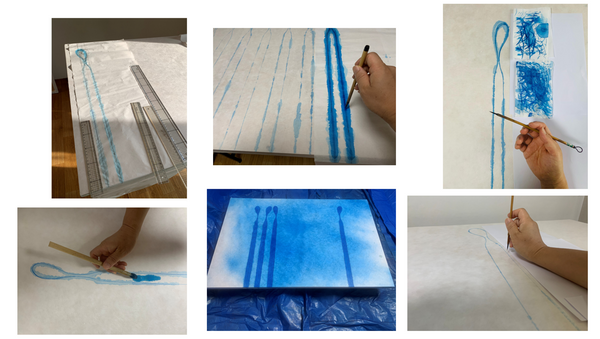
Working Process (Sayu Series)
Permeation
As water and pigment permeate the hanji, they leave behind unpredictable traces. The spreading of the medium reveals a painterly passage of time, where intention and chance exist in constant dialogue.
작업과정 (사유시리즈)
스밈물과 안료가 한지 위로 스며들며 예측할 수 없는 흔적을 만든다. 번짐의 과정은 통제와 우연이 공존하는 회화적 시간을 드러낸다.

Working Process (Sayu Series)
Constructing the Color Field
Layers of pigment are repeatedly built up, transforming the pictorial surface into a unified field of color. The figures gradually dissolve into the background, blurring the boundaries between space and existence.
작업과정 (사유시리즈)
색면 구축안료를 반복적으로 중첩하여 화면 전체를 하나의 색면으로 확장한다. 형상은 배경 속으로 스며들며 공간과 존재의 경계를 흐린다.

Working Process (Sayu Series)
Harmonization
The placement and density of the figures, together with the balance of color, are refined to establish the overall tension of the composition. Each painting conveys a unique emotional resonance and a distinct state of contemplation.
작업과정 (사유시리즈)
조율형상의 위치와 밀도, 색의 균형을 조정하며 화면의 긴장을 완성한다. 각 화면은 서로 다른 정서와 사유의 상태를 담아낸다.

Working Process (Permeate Series)
Creating the Form
Aluminum is cut and shaped into simplified forms that symbolize the human figure. Repeated throughout the work, these forms become the basic units of the Permeate Series, functioning as signs that extend beyond individual identity.
작업과정 (스밈시리즈)
알루미늄을 가위로 절단하고 구부려 인간을 상징하는 단순화된 형상을 만든다. 반복적으로 제작된 형상은 스밈 시리즈의 기본 단위가 되며, 개별적 존재를 넘어 하나의 기호로 기능한다.

Working Process (Permeate Series)
Constructing the Surface
Gesso is applied to the aluminum forms and left to dry before layers of hanji are carefully attached to the surface. Enveloping the rigid metal structure, the hanji introduces a softer texture and material presence, transforming the forms and giving them a new visual character.
작업과정 (스밈시리즈)
제작된 알루미늄 형상 위에 젯소를 바르고 건조시킨 뒤 한지를 입혀 표면을 구축한다. 한지는 금속의 단단한 구조를 감싸며 부드러운 질감과 물성을 더하고, 형상에 새로운 표정을 부여한다.

Working Process (Permeate Series)
Permeation of Color
Color is allowed to permeate the hanji-covered human forms, creating traces of existence and relationships. Figures facing upward and downward symbolize different states of being, while each form is continuously influenced and transformed through its encounters with the external world.The repeatedly produced forms are arranged within both pictorial and spatial compositions, establishing relationships with one another. The colors absorbed into each figure remain as traces of time and experience. Through this process, the work reveals human beings as entities that are constantly shaped and transformed through their interactions with the world.
작업과정 (스밈 시리즈)
한지로 구축된 인간 형상 위에 색을 스며들게 하며 존재와 관계의 흔적을 만들어간다. 위를 향한 형상과 아래를 향한 형상은 서로 다른 존재의 상태를 상징하며, 외부 세계와의 접촉 속에서 형상은 끊임없이 영향을 받고 변화한다. 반복적으로 제작된 형상들은 화면과 공간 안에 배치되며 관계를 형성하고, 각각의 형상에 스며든 색은 시간과 경험의 흔적으로 남는다. 이러한 과정은 인간이 세계와 만나며 변화하고 형성되는 존재의 모습을 드러낸다.

Exhibition Study (2020)
This model was developed to explore exhibition strategies for the Sayu Series. Through the arrangement of repeated figures and their relationship to the viewer, it investigates how the conceptual and visual language of the paintings can extend beyond the two-dimensional surface and unfold within an exhibition space.
전시 구상 연구 (2020)
사유 시리즈의 전시 구성을 연구하기 위해 제작한 모형이다. 반복되는 형상과 관람자의 관계를 공간 안에서 실험하며, 평면 작업이 전시장 환경 속에서 어떻게 확장될 수 있는지 탐색하였다.

Exhibition Study (2020)
This model was developed to explore the relationships created by repeated forms and color within an exhibition environment. As viewers move through the space, the distances, rhythms, and visual connections between the works continuously change. The study investigates how the language of painting can extend beyond the two-dimensional surface and unfold as a spatial experience.
전시 구상 연구 (2020)
반복되는 형상과 색채가 전시장 안에서 형성하는 관계를 탐색하기 위해 제작한 모형이다. 관람자의 이동과 시선에 따라 작품 간의 거리와 리듬이 변화하며, 평면 작업의 공간적 확장 가능성을 연구하였다.


The Weight of Sayu (2024)
This installation consists of red balloons filled with water and suspended from the ceiling, connected to one another by red strings that structure the space. The balloons symbolize both a mass of blood associated with the beginning of life and the primordial source of existence, while the strings evoke the umbilical cord that sustains and supports the weight of life.Over time, the water contained within the balloons gradually evaporates in response to the surrounding environment, causing their volume to diminish. This transformation reveals the finitude and fragility of human existence. Through the physical processes of evaporation and gravity, the work visualizes the weight of life, the passage of time, and the inevitability of disappearance.By tracing these subtle yet continuous changes, the installation explores the meaning of human existence and the transient nature of life.
사유의 무게 (2024)
붉은 풍선에 물을 담아 천장에 매달고, 붉은 실로 서로 연결하여 공간을 구성하였다. 풍선은 생명의 시작을 상징하는 핏덩이이자 존재의 근원을 의미하며, 실은 삶의 무게를 지탱하는 탯줄을 상징한다. 풍선 속 물은 시간의 흐름과 공간의 환경에 따라 점차 증발하고 부피가 줄어들며, 인간 존재의 유한성과 불안정성을 드러낸다. 이 작업은 물의 변화와 중력의 작용을 통해 삶의 무게와 시간, 소멸의 과정을 시각화하며 인간 존재의 의미를 탐구한다.

Sayu Series (2024)
Figures of varying colors are scattered across the surface of the painting. They exist in proximity yet never touch, separated yet connected through invisible relationships. The vacant spaces become fields of silence and contemplation, while each figure inhabits the composition carrying its own memories and passage of time.
사유 시리즈 (2024)
서로 다른 색의 형상들은 화면 위에 흩어져 존재한다. 가까이 있지만 닿지 않고, 떨어져 있지만 관계를 맺는다. 비워진 공간은 침묵의 여백이자 사유의 공간이며, 각각의 형상은 저마다의 기억과 시간을 품은 채 화면 안에 머문다.

Permeate Series (2023)
Using aluminum and hanji, I create simplified forms that symbolize the human figure. Consisting only of a head and torso, with the arms and legs omitted, these forms emphasize states of existence and contemplation rather than action.The figures appear in two orientations. Upward-facing forms symbolize a state of being untouched by the external world, while downward-facing forms represent human beings cast into the realities of life.The colors that permeate the forms are traces of relationships and experiences accumulated through encounters with others. Human beings are continuously shaped and transformed through their interactions with the world. The downward-facing figures reveal the conditions of existence as lived within gravity, time, and environment, while the permeating and spreading colors visualize the process of change that emerges through the meeting of the self and the world.Through these forms and traces, the work reflects upon existence, relationships, and the meanings that human beings construct throughout the course of life.
스밈 시리즈 (2023)
알루미늄과 한지를 이용해 인간을 상징하는 형상을 제작한다. 팔과 다리를 생략한 머리와 몸통은 행위보다 존재와 사유의 상태를 드러낸다. 형상은 두 개의 방향으로 나타난다. 위를 향한 형상은 외부 세계에 물들지 않은 존재의 상태를 상징하며, 아래를 향한 형상은 세상 속으로 던져진 인간을 의미한다.외부 존재와의 접촉 속에서 스며든 색은 관계와 경험의 흔적이며, 인간은 끊임없이 영향을 주고받으며 변화한다. 아래로 향한 형상은 중력과 시간, 환경 속에서 살아가는 존재의 조건을 드러내고, 스며들고 번지는 색의 흔적은 인간과 세계가 만나 형성하는 변화의 과정을 보여준다. 이 작업은 존재와 관계, 그리고 삶 속에서 형성되는 인간의 의미를 사유한다.

Sayu Series (2023)
The repeated human figures establish relationships through variations in color and spatial distance. While each figure exists as an individual presence, together they form a collective constellation, generating a shared human landscape within the composition.Layers of lines and color accumulated on the hanji surface reveal traces of memories and experiences shaped over time. Through these layered marks, the work investigates the meanings of human existence and the relationships that connect individuals to one another.
사유 시리즈 (2023)
반복되는 인간 형상들은 서로 다른 색과 거리 속에서 관계를 형성한다. 형상들은 개별적 존재로 화면에 머물지만, 동시에 하나의 군집을 이루며 집단적 풍경을 만들어낸다. 한지 위에 축적된 선과 색의 층은 시간 속에 형성된 기억과 경험의 흔적을 드러내며, 인간 존재와 관계의 의미를 탐구한다.

Sayu Series (2022–2023)
The pictorial surface is constructed through the repeated accumulation of red human forms. Layered and intertwined, the figures merge into a collective landscape, while the recurring lines register traces of memories and experiences sedimented over time.Occupying the entire composition, the figures transcend individual identity and evoke the dynamics of relationships and collective existence. Through this process of repetition and accumulation, the work visualizes the traces of human life and explores the meanings embedded within human existence.
사유 시리즈 (2022-2023)
붉은 인간 형상을 반복적으로 중첩하며 화면을 구축한다. 형상들은 서로 겹쳐지고 축적되며 하나의 집단적 풍경을 형성하고, 반복되는 선은 시간 속에 쌓여가는 기억과 경험의 흔적을 드러낸다. 화면을 가득 채운 형상들은 개별적 존재를 넘어 관계와 집단의 흐름을 보여주며, 인간 존재와 삶의 흔적을 시각화한다.

Blue Sayu Series (2021)
This series explores traces of human existence and relationships through the movement of color as it permeates and spreads across the surface of hanji. Repeated layers of lines and color hold memories and experiences accumulated through time, while the faintly remaining figures suggest shifting states of human consciousness.The diffusion and permeation of color reveal the weight and lightness of life, as well as the emotional flows that emerge through human relationships. Through these processes, the work visualizes the continual transformation of the self within the passage of time and experience.
블루 사유 시리즈 (2021)
한지 위에 스며들고 번지는 색의 흐름을 통해 인간 존재와 관계의 흔적을 탐구한다. 반복되는 선과 색의 층은 시간 속에 축적된 기억과 경험을 담아내며, 희미하게 남겨진 형상은 변화하는 인간 의식의 상태를 드러낸다. 색의 확산과 스밈의 과정은 삶의 무거움과 가벼움, 그리고 관계 속에서 형성되는 감정의 흐름을 보여준다.

Sayu Series (2020)
Human beings living in contemporary society often experience solitude and anxiety within complex networks of relationships and social structures. The simplified figures within the composition reflect this condition of human existence, while the accumulated layers of color register the passage of time through which memories and experiences are formed.The traces left by permeation reveal an inner state suspended between the weight of life and the desire to become lighter. Through these subtle marks and accumulations, the work explores the emotional landscape of human existence and the ways in which individuals navigate the complexities of life.
사유 시리즈 (2020)
현대사회를 살아가는 인간은 수많은 관계와 질서 속에서 고독과 불안을 경험한다. 화면 속 단순화된 형상은 그러한 인간 존재의 모습을 담고 있으며, 반복적으로 축적된 색의 층은 기억과 경험이 쌓여가는 시간을 드러낸다. 스밈의 흔적은 삶의 무게와 가벼워지려는 욕망 사이에서 흔들리는 인간의 내면을 보여준다.

Sayu Series (2020)
Human beings exist within intricate networks of relationships. The repeated red lines traversing the surface connect and intersect like capillaries flowing through the body, forming traces of human connection. While each figure maintains its individuality, it simultaneously becomes part of a larger collective presence.The accumulated lines suggest the ways in which time, memory, and experience permeate the body and settle within human existence. Through this process of connection and accumulation, the work reflects upon the weight and meaning of being shaped through relationships.
사유 시리즈 (2020)
인간은 수많은 관계 속에서 살아간다. 화면 위에 반복적으로 그어진 붉은 선들은 몸속을 흐르는 모세혈관처럼 서로 연결되고 교차하며 관계의 흔적을 만든다. 개별 형상은 독립된 존재이지만 동시에 하나의 집단을 이루고, 축적된 선들은 시간과 기억이 몸 안에 스며드는 과정을 드러낸다. 이 작업은 관계 속에서 형성되는 인간 존재의 무게와 의미를 드러낸다.

Fragments of Graphite (2021)
The work is constructed through the repetitive act of drawing and smudging graphite lines across the surface. Fragments generated through the friction between graphite and paper accumulate into a hazy atmospheric field, where lingering figures evoke conditions of collectivity and solitude, connection and separation.The repeated accumulation of lines records traces of memories and experiences shaped through human relationships. Through these deposits of graphite and the ambiguity of the pictorial space, the work reflects upon the search for meaning and existence within an uncertain reality.
흑연의 파편 (2021)
흑연 선을 반복적으로 그린 뒤 문지르는 과정을 통해 화면을 구축한다. 종이와 흑연의 마찰로 생성된 파편들은 뿌연 공간을 형성하고, 그 위에 남겨진 형상들은 군집과 고립, 관계와 거리의 상태를 드러낸다. 반복된 선의 축적은 인간관계 속에서 형성되는 기억과 경험의 흔적을 보여주며, 이 작업은 불확실한 현실 속에서 존재의 의미를 탐구한다.

Sayu Series (2021, Detail)
This enlarged detail focuses on the boundaries and layers of color created through the permeation of pigment into hanji. The red fields of color and traces of diffusion reveal a process where intention and chance exist in constant dialogue. Within this atmospheric surface, the figure remains as a trace of being, carrying the accumulated presence of time and memory.
사유 시리즈 (2021, 부분)
안료가 한지에 스며들며 형성한 경계와 색의 층을 확대하여 보여준다. 붉은 색면과 번짐의 흔적은 통제와 우연이 공존하는 과정을 드러내며, 화면 속 형상은 시간과 기억이 축적된 존재의 흔적으로 남는다.

Sayu Series (2019)
This work explores contemplation and the traces of human relationships through simplified human forms and the repeated layering of lines. The intertwining and intersecting marks evoke the movement of memory and emotion, while the accumulated traces across the surface reveal the trajectories of human existence shaped through encounters and relationships.Through repetition and accumulation, the work reflects upon the ways in which individuals are formed, connected, and transformed within the networks of human experience.
사유 시리즈 (2019)
단순화된 인간 형상과 반복되는 선의 중첩을 통해 인간 내면의 사유와 관계의 흔적을 표현하였다. 서로 얽히고 교차하는 선들은 기억과 감정의 흐름을 암시하며, 화면 위에 축적된 흔적들은 관계 속에서 형성되는 인간 존재의 궤적을 보여준다.

Sayu Series (2019)
The solitary figure remains in silence, yet is connected to innumerable unseen relationships. The lines crossing the surface trace the movement of memories and emotions that have passed through time, while the layered marks become temporal sediments left behind by lived experience.Accumulated on the surface of hanji, these lines reflect the contemplative journey of human existence—an existence continuously shaped and transformed through its encounters with the world.
사유 시리즈 (2019)
홀로 선 형상은 침묵 속에 머물지만 보이지 않는 수많은 관계와 연결되어 있다. 화면을 가로지르는 선들은 스쳐간 기억과 감정의 흐름이며, 겹쳐진 흔적들은 삶이 지나간 자리에 남겨진 시간의 결이다. 한지 위에 축적된 선들은 세계와 만나며 변화하는 인간 존재의 사유를 담아낸다.

Sayu Series (2017–2018)
Human beings are in constant exchange with the world around them, continuously shaping and being shaped by their environments and relationships. The figures within the composition symbolize individual existence, while the repeated lines and layered colors register the traces of experiences and external influences that become embedded within the self.As pigment permeates and spreads across the surface of hanji, it evokes the shifting inner states of human beings, resonating like frequencies that meet and interact. The accumulated marks surrounding the figures reveal the passage of time and the ongoing transformation of human existence through its encounters with the external world.
사유 시리즈 (2017-2018)
인간은 끊임없이 외부 환경과 관계를 맺으며 영향을 주고받는다. 화면 속 형상은 고유한 존재를 상징하며, 반복되는 선과 중첩된 색의 층은 외부의 자극과 경험이 인간에게 남기는 흔적을 나타낸다. 한지에 스며들고 번지는 색은 서로 다른 주파수가 만나 공명하듯 변화하는 인간의 내면을 드러내며, 형상 주변에 축적된 흔적들은 외부 세계와 관계 맺으며 변화하는 인간 존재의 시간을 드러낸다

Sayu Series (2017–2018)
The simplified human figure stands alone within an expansive field of emptiness, evoking solitude and contemplation. Layers of ink permeating the surface of hanji and their softened boundaries reflect the gradual accumulation of memory and emotion over time.Through a restrained visual language of minimal form and color, the work reflects upon the weight of existence and poses questions concerning the fundamental nature of human beings.
사유 시리즈 (2017-2018)
단순화된 인간 형상은 넓은 여백 속에 홀로 존재하며 인간 내면의 고독과 사유를 드러낸다. 한지 위에 스며든 먹의 층과 흐릿한 경계는 기억과 감정이 축적되는 과정을 담고 있으며, 최소한의 형상과 색채를 통해 존재의 무게와 인간의 본질에 대한 질문을 제기한다.

Sayu Series (2018)
The simplified human figure represents the individual navigating contemporary society. The expansive field of empty space becomes a realm of solitude and silence, while the bowed posture of the figure suggests an act of contemplation directed toward life and existence.Reduced to its most essential form, the figure embodies the anxieties, questions, and persistent search for meaning that accompany the human condition. Through this restrained visual language, the work reflects upon the nature of existence and the experience of being human.
사유 시리즈 (2017-2018)
단순화된 인간 형상은 넓은 여백 속에 홀로 존재하며 인간 내면의 고독과 사유를 드러낸다. 한지 위에 스며든 먹의 층과 흐릿한 경계는 기억과 감정이 축적되는 과정을 담고 있으며, 최소한의 형상과 색채를 통해 존재의 무게와 인간의 본질에 대한 질문을 제기한다.

Absorption (2017)
Subtle emotions permeate the self gradually and often unnoticed. The human figure encounters a space saturated with color, absorbing the external world into its being. The absorbed colors become traces of memory and experience, accumulating within the self and slowly transforming it.Through this process of absorption, the work explores how human existence is shaped through encounters, relationships, and continuous engagement with the world.
흡수 (2017)
미세한 감정들은 알지 못하는 사이 서서히 스며든다. 인간 형상은 색이 담긴 공간과 접촉하며 외부 세계를 몸 안으로 받아들인다. 흡수된 색은 경험과 기억의 흔적이 되어 존재 안에 축적되고, 인간은 그렇게 세상에 물들며 변화한다. 이 작업은 외부와의 만남 속에서 형성되는 인간 존재의 과정을 담고 있다.

Permeate Series: Installation Study Drawing (2017)
This conceptual drawing was created to explore the potential spatial extension of the Permeate Series. Repeated human forms are arranged throughout the exhibition space, distributed across walls and architectural structures to examine the relationship between individual presence and collective experience.The drawing investigates how traces of contemplation might expand beyond the surface of painting and unfold within space. As a study, it documents a process of connecting painting and installation, existence and relationships, image and environment.
스밈 시리즈 설치 구상 드로잉 (2017)
반복되는 인간 형상을 공간 안에 배치하며 평면 작업의 확장 가능성을 탐색한 설치 구상 드로잉이다. 벽면과 구조물 위에 분포된 형상들은 개별 존재와 집단의 관계를 드러내며, 사유의 흔적이 공간 속에서 어떻게 확산될 수 있는지를 실험한다. 이 드로잉은 회화와 공간, 존재와 관계를 연결하기 위한 과정의 기록이다.

Permeate Series (2016)
This work reduces the human figure to its most essential form through the permeation of color into hanji. Arranged irregularly across the surface, the figures are accompanied by traces of absorbed color and shadow, suggesting the transformations that emerge through encounters with the external world.As materials permeate a surface and leave lasting traces, human beings are likewise shaped through experiences and relationships. Through this process of absorption and transformation, the work reflects upon the formation of human existence and identity.
스밈 시리즈 (2016)
한지와 색의 스밈을 통해 인간 형상을 최소한의 형태로 남겼다. 형상은 화면 위에 불규칙하게 배치되며, 흡수된 색의 흔적과 그림자는 존재가 외부 세계와 관계를 맺으며 형성되는 변화를 드러낸다. 물질이 스며들고 흔적을 남기듯 인간 또한 경험과 관계 속에서 변화하며 자신의 존재를 형성해 간다.

Weight of Sayu Series: Installation Study Drawing (2024)
This conceptual drawing was developed to explore the spatial realization of the weight of life and the origins of existence through the use of red balloons and connecting strings. Each suspended balloon symbolizes an individual life and presence, while the repetitive clustered arrangement reflects the relationship between the individual and society.Drawn downward by gravity, the forms suggest the burden and fragility of life. At the same time, the interconnected structure evokes the invisible ties that bind human beings together. As an installation study, the drawing serves as a record of a process that seeks to expand contemplation on existence, time, and mortality into the realm of space.
사유의 무게 시리즈 설치 구상 드로잉 (2024)
붉은 풍선과 실을 통해 삶의 무게와 존재의 근원을 공간 안에 구현하고자 한 설치 구상 드로잉이다. 개별적으로 매달린 풍선들은 하나의 생명이자 존재를 상징하며, 반복과 군집의 구조는 개인과 사회의 관계를 드러낸다. 중력에 의해 아래로 향하는 형태는 삶의 무게를 암시하며, 이 드로잉은 존재와 시간, 소멸에 대한 사유를 공간으로 확장하기 위한 과정의 기록이다.

Unrecognizable Being and Monologue (2005–2006)
The human figure inhabits a space of silence while confronting an unseen presence. The dark forms that cross or penetrate the body symbolize an unrecognizable entity situated between consciousness and the unconscious. Though undefined and elusive, this presence continually exerts its influence, provoking questions of existence and generating an ongoing inner monologue.The reduced figure and expansive emptiness establish a space of solitude and contemplation. The figure attempts to sense and comprehend the invisible presence, yet remains unable to fully grasp it, returning repeatedly to reflection and self-questioning. Situated between presence and absence, recognition and forgetting, the work explores the human desire to affirm and understand its own existence.
인식할 수 없는 존재 그리고 독백 (2005-2006)
화면 속 인간 형상은 보이지 않는 존재와 마주한 채 침묵 속에 머문다. 형상 위를 가로지르거나 관통하는 검은 덩어리는 인간의 의식과 무의식 사이에 존재하는 인식할 수 없는 존재를 상징한다. 그것은 명확히 규정되지 않지만 끊임없이 인간에게 영향을 미치며, 존재에 대한 질문과 독백을 불러온다.최소한의 형상과 넓은 여백은 고독과 침묵의 공간을 형성한다. 화면 속 인간은 보이지 않는 존재를 감지하려 하지만 끝내 완전히 이해하지 못한 채 사색과 독백을 반복한다. 이 작업은 존재와 부재, 인식과 망각 사이에서 인간이 스스로의 존재를 확인하려는 과정을 담고 있다.
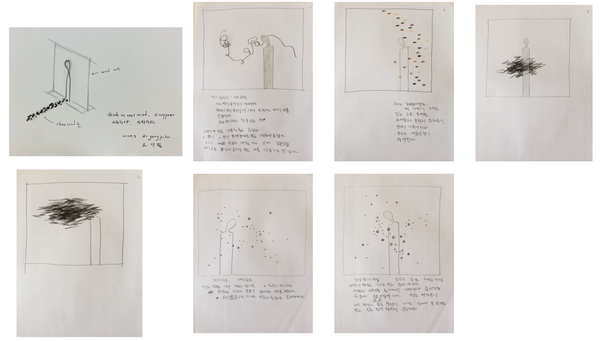
Sketches (2005)
These early conceptual sketches explore questions of existence and perception through a range of visual experiments. The human figure is situated within uncertain conditions, confronting invisible forces, relationships, memories, and emotional flows. Points, lines, masses, and traces operate as distinct formal languages, visualizing psychological movements that emerge between consciousness and the unconscious.Dark forms and dispersed marks suggest the presence of something unrecognizable yet influential. The tensions and conflicts that arise around the figures reflect the anxiety, contemplation, and self-questioning generated through the human effort to understand the world and locate oneself within it.As a record of formal experimentation, these sketches mark an early stage in an ongoing investigation into human existence and the dynamics of inner experience.
에스키스 (2005)
존재와 인식에 대한 질문을 다양한 형식으로 탐색한 초기 구상 드로잉이다. 화면 속 인간 형상은 보이지 않는 힘, 관계, 기억, 감정의 흐름과 마주하며 불확실한 상황 속에 놓여 있다. 점, 선, 덩어리, 흔적 등 서로 다른 조형 언어들은 인간의 의식과 무의식 사이에서 발생하는 심리적 움직임을 시각화한 것이다.검은 덩어리와 흩어지는 점들은 인식할 수 없는 존재의 흔적이며, 형상 주변에 형성되는 긴장과 충돌은 인간이 세계를 이해하고 자신을 인식하는 과정에서 발생하는 불안과 사유를 드러낸다. 이 에스키스들은 인간 존재와 내면의 움직임을 탐구하기 위한 조형적 실험의 기록이다.

Permeate Series (2005–2006)
The upward-facing and downward-facing figures represent two conditions of existence. One suggests a state not yet touched by the world, while the other embodies a being cast into the complexities of life.Human beings move through countless relationships, events, and the passage of time. Invisible influences permeate both body and consciousness, leaving traces that shape and transform existence. Suspended in space, the figures evoke a condition of not fully belonging anywhere, while remaining in continuous contact with the world and its forces.Through these forms, the work explores how human beings are affected, transformed, and ultimately formed through their encounters with the world. It reflects upon existence as an ongoing process of becoming rather than a fixed state of being.
스밈 시리즈 (2005–2006)
위를 향한 형상과 아래를 향한 형상은 존재의 두 상태를 보여준다. 하나는 아직 세상에 물들지 않은 상태이며, 다른 하나는 삶 속으로 던져진 존재이다.태어난 인간은 수많은 관계와 사건, 시간의 흐름 속을 지나간다. 보이지 않는 영향들은 몸과 의식에 스며들고, 존재는 그 흔적들을 품은 채 변화한다. 허공에 매달린 형상은 어디에도 완전히 속하지 못한 인간의 상태이자, 세계와 끊임없이 접촉하며 흔들리는 존재의 모습이다.이 작업은 인간이 세계 속에서 영향을 받고 변화하며 자신의 존재를 만들어가는 과정을 드러낸다.

Green Story (2002)
This body of work began during a period marked by personal change and experiences of loss. Through painting and installation centered on human figures and green imagery, it visualizes questions concerning existence and life.Green functions as a symbol of life, growth, and recovery, while also serving as a trace of sensations preserved in memory. The figures situated within the pictorial and spatial environments reveal the inner condition of human beings, where solitude and anxiety intersect with hope and loss. They reflect a state of existence that is constantly shifting and evolving. Simplified forms move beyond the representation of specific individuals and instead symbolize the human condition itself.The work originates from questions about how human beings live and what they leave behind. This early inquiry into existence later developed into the Sayu Series and the Permeate Series, becoming the foundation of the artist’s ongoing practice.
그린스토리 (2002)
삶의 변화와 상실을 경험하던 시기에 시작된 작업이다. 인간 형상과 녹색의 이미지를 중심으로 회화와 설치를 병행하며 존재와 삶에 대한 질문을 시각화하였다.녹색은 생명과 성장, 회복의 상징이자 기억 속에 남아 있는 감각의 흔적이다. 화면과 공간에 놓인 형상들은 고독과 불안, 희망과 상실이 교차하는 인간의 내면을 드러내며, 끊임없이 변화하는 존재의 상태를 보여준다. 단순화된 형상들은 특정 개인을 넘어 인간 존재 자체를 상징한다.이 작업은 인간은 어떻게 살아가며 무엇을 남기는가에 대한 질문에서 출발한다. 존재에 대한 초기의 탐구는 이후 「사유 시리즈」와 「스밈 시리즈」로 이어지며 오늘날 작업 세계의 출발점이 되었다.
Development of the Work
For many years, questions surrounding human existence have been the point of departure for my artistic practice.
In my early works, Green Story and Unrecognizable Being and Monologue, I explored questions of existence and perception, solitude, and the meaning of life. Later, in the Permeate Series, I turned my attention to the ways human beings are transformed through their relationships with the external world. The permeating and diffusing colors function as traces of memory, emotion, and human connection, revealing individuals as beings in a constant state of change.
In the Sayu Series, I visualized traces of contemplation through repeated human forms. The tilted figures symbolize individuals standing before the weight of life and existential questions, while the accumulation of lines and color reveals the passage of time embedded within human existence.
My recent work expands these inquiries into broader dimensions of time and space. In The Weight of Sayu, I explore the weight and finitude of life within a spatial context. In For a Moment, Stardust Becomes Human, I consider human beings as temporary presences within cosmic time.
Ultimately, my work returns to a single set of questions:
What sustains human life?
And why do we exist?
작업의 흐름
나는 오랫동안 인간 존재에 대한 질문을 작업의 출발점으로 삼아 왔다.
초기 작업인 「그린스토리」와 「인식할 수 없는 존재 그리고 독백」에서는 존재와 인식, 고독과 삶의 의미에 대한 질문을 다루었다. 이후 「스밈 시리즈」에서는 인간이 외부 세계와 관계를 맺으며 변화하는 과정에 주목하였다. 스며들고 번지는 색은 기억과 감정, 관계의 흔적이며 인간은 그 과정을 통해 끊임없이 변화하는 존재로 나타난다.
「사유 시리즈」에서는 반복되는 인간 형상을 통해 사유의 흔적을 시각화하였다. 기울어진 형상은 삶의 무게와 질문 앞에 선 인간을 상징하며, 선과 색의 축적은 인간 존재가 지나온 시간의 흔적을 드러낸다.
최근 작업은 인간 존재를 보다 넓은 시간과 공간의 관점으로 확장하고 있다. 「사유의 무게」에서는 삶의 무게와 유한성을 공간 속에 드러내고, 「별의 먼지가 잠시 인간이 되어」에서는 인간을 우주적 시간 속의 존재로 바라본다.
나의 작업은 결국 하나의 질문으로 돌아온다.
인간은 무엇으로 살아가는가.
그리고 우리는 왜 존재하는가.

Time with the Waves (2024)
Yeomsup is the ritual of preparing the deceased for their final journey by washing the body and dressing it in burial garments. More than a funeral procedure, it is a symbolic act that marks the passage between death and a new beginning, a process through which one state of existence transforms into another.
This work begins with collecting broken pieces of driftwood and discarded objects from the seashore, painting them, and reassembling them into human-like forms. Shaped by waves, wind, and time, these fragments are given a renewed presence and stand once again as figures along the shore.
Like the act of yeomsup, caring for discarded and damaged materials and granting them a new form reflects the cycle of disappearance and emergence, loss and renewal. Altered by nature, these objects seem to acquire a new life, reminding us that all beings continuously change and move through cycles of transformation.
Time with the Waves is a reflection on beings that disappear and re-emerge within the flow of nature's time, and on the enduring possibility of hope and regeneration.
파도와 함께한 시간 (2024)
염습은 죽은 이를 씻기고 수의를 입혀 마지막 길을 준비하는 행위이다. 그것은 단순한 장례 절차가 아니라 죽음과 새로운 시작 사이를 잇는 의식이며, 존재가 다른 상태로 옮겨가는 과정을 상징한다.
이 작업은 해변에서 수집한 파손된 나무와 사물들을 채색하고 인간의 형상으로 다시 세우는 행위에서 출발한다. 파도와 바람, 시간을 견디며 떠밀려온 나무들은 새로운 모습으로 다시 태어나고, 해변 위에 선 존재가 된다.
죽은 이를 염습하듯 버려지고 파손된 사물들을 돌보고 새로운 형상을 부여하는 과정은 소멸과 생성, 상실과 재생의 순환을 담고 있다. 자연에 의해 변화된 사물들은 다시 생명을 얻은 듯한 모습으로 우리 앞에 서며, 모든 존재가 끊임없이 변화하고 순환한다는 사실을 보여준다.
이 작업은 자연의 시간 속에서 사라지고 다시 태어나는 존재들에 대한 이야기이며, 희망과 재생의 가능성에 대한 기록이다.

Direction of Being (2017)
A moment when existence awakens and begins to move in search of its own direction.
The work reveals a human figure through cuts made in the surface of paper. The cut-out form rises from the flat plane into space, while the empty space left behind remains as a trace of its emergence. A single figure exists simultaneously as a raised form and as a void, revealing the relationship between presence and trace, the present and possibility.
The simplified human figure does not represent a specific individual, but human existence itself—an existence that thinks, questions, and reflects. Emerging through the surface of the paper, the figure suggests the human condition of continually seeking direction and moving forward.
Through the movement from plane to space, this work explores human existence as it searches for its own path through life.
Direction of Being No.6 (Black), Cut Paper, 15 × 15 cm, 2017
존재의 방향 (2017)
존재가 깨어나고, 스스로의 방향을 찾아 움직이기 시작하는 순간
종이 표면을 절개하여 인간 형상을 드러낸 작업이다. 오려진 형상은 평면을 벗어나 공간으로 일어서고, 비어 있는 자리는 그 존재가 지나온 흔적처럼 남는다. 하나의 형상은 솟아오른 형태와 빈 자리로 동시에 존재하며, 존재와 흔적, 현재와 가능성 사이의 관계를 드러낸다.
단순화된 인간 형상은 특정한 개인이 아니라 생각하고 질문하며 살아가는 인간 존재 자체를 상징한다. 종이의 표면을 뚫고 일어나는 형상은 끊임없이 방향을 모색하고 앞으로 나아가는 인간의 상태를 암시한다.
이 작업은 평면에서 공간으로 확장되는 움직임을 통해 삶 속에서 자신의 방향을 찾아가는 인간 존재를 탐구한다.
Direction of Being , 종이에 칼 오리기, 15 × 15 cm, 2017

Echoes of the Rapids (2014)
Acrylic Cylinder, Water, Balloon-shaped Form, Motor, Sensor, Sound Device, Variable Installation (Project Proposal)
When a viewer sends a signal through a mobile phone, a balloon-shaped form partially submerged in water begins to move. This subtle movement generates ripples and currents across the water’s surface, gradually expanding throughout the surrounding space. At the same time, the clear resonance of a bell emerges, transforming an invisible signal into a sensory experience of sound.
The work visualizes how a small intervention can be amplified through waves and sound, extending its influence beyond its point of origin. The viewer’s action becomes an unseen force that alters the flow of water, leaving traces that continue to resonate within the space.
Echoes of the Rapids explores the process through which individual actions expand through relationships and mediation. The ripples and sounds function as metaphors for invisible connections, visualizing the ways in which thoughts, emotions, memories, and human relationships influence one another and spread outward. The work investigates how subtle actions can generate larger flows and how unseen structures of connection shape our experience of the world.
여울의 메아리 (Echoes of the Rapids)
2014
아크릴 원통, 물, 풍선 형태의 조형물, 모터, 센서, 음향장치, 가변설치 (구상안)
관객이 휴대전화로 신호를 보내면 물속에 부분적으로 잠긴 풍선 형태의 조형물이 움직이기 시작한다. 작은 움직임은 수면 위에 여울과 파동을 만들고, 물결은 공간 속으로 천천히 확장된다. 동시에 울려 퍼지는 맑은 종소리는 보이지 않는 신호가 또 다른 감각의 울림으로 전환되는 순간을 드러낸다.
작품은 하나의 미세한 개입이 물결과 소리로 증폭되며 주변에 영향을 미치는 과정을 보여준다. 관객의 행위는 보이지 않는 힘이 되어 물의 흐름을 변화시키고, 그 흔적은 공간 속에 울림으로 남는다.
《여울의 메아리》는 개별적인 움직임이 관계와 매개를 통해 확장되는 과정을 탐구한 작업이다. 물결과 소리는 보이지 않는 연결의 은유이며, 인간의 생각과 감정, 기억과 관계가 서로에게 영향을 주며 퍼져 나가는 방식을 시각화한다.

Installation View (Simulation)
설치 전경(시뮬레이션)

Stardust Becoming Human for a Moment
Stone, Copper Wire, Variable Installation, 2026
The material that composes us was forged long ago within the interior of stars. As stars died and dispersed their elements throughout the universe, those elements gathered again to become rocks, living organisms, and eventually human beings.
The two stones used in this work symbolize stars. Stars continuously undergo cycles of formation and destruction, generating countless elements that drift through space before taking on new forms of existence. Rising between the stones, the copper-wire figure represents this material temporarily assuming a human form.
Copper is both an element created within stars and a material that conducts energy. The figure, formed from a simple line, does not represent a specific individual but human existence itself—an existence that thinks, questions, and reflects. The faceless form shifts attention away from personal identity toward being itself and the state of contemplation.
Scattered across the floor, the figures are positioned like stars dispersed throughout the universe, or like people living their individual lives. Each exists independently, yet all share the same space, forming relationships and creating a larger flow.
Human beings are not eternal. We are born from stardust, live briefly as human beings—thinking, remembering, and forming relationships—and eventually return to nature and the universe. This work considers humanity not as an isolated entity, but as a temporary state of matter taking form within the vast timescale of the cosmos.
We are stardust, briefly becoming human.
별의 먼지가 잠시 인간이 되어
돌, 구리선, 가변설치, 2026
우리를 이루는 물질은 오래전 별의 내부에서 만들어졌다. 별이 소멸하며 우주로 흩어진 원소들은 다시 모여 암석이 되고, 생명이 되고, 인간이 되었다.
작품에 사용된 두 개의 돌은 별을 상징한다. 별은 생성과 소멸을 반복하며 수많은 원소를 만들어 내고, 그 물질들은 우주 공간을 떠돌다 다시 새로운 존재의 형태를 이룬다. 돌과 돌 사이에서 솟아 오른 구리 선의 형상은 그러한 물질이 잠시 인간의 모습을 얻은 상태를 나타낸다.
구리는 별의 내부에서 생성된 원소이자 에너지를 전달하는 물질이다. 단순한 선으로 이루어진 형상은 특정한 개인이 아니라 생각하고 질문하며 살아가는 인간 존재 자체를 상징한다. 얼굴이 없는 형상은 인간의 개별적인정체성보다 존재 그 자체와 사유의 상태에 주목한다.
바닥 위에 흩어져 배치된 형상 들은 우주 공간에 존재하는 별들처럼, 혹은 각자의 삶을 살아가는 사람들처럼 서로 다른 위치에 놓여 있다. 각각은 독립적으로 존재하지만 같은 공간 안에서 관계를 맺으며 하나의 흐름을 이룬다.
인간은 영원한 존재가 아니다. 우리는 별의 먼지로부터 태어나 잠시 인간으로 살아가며 생각하고 기억하고 관계를 맺는다. 그리고 다시 자연과 우주의 일부로 돌아간다. 이 작업은 인간을 하나의 독립된 존재가 아니라 긴 우주의 시간 속에서 잠시 형상을 얻은 물질의 상태로 바라본다.
우리는 별의 먼지이며, 잠시 인간이 된 존재다.